 mattandClaude
ad9c457ea7
Implements ESP32_Soil_Moisture_Node_PRD.md on the VCC-GND Studio
YD-ESP32-S3 (ESP32-S3-WROOM-1) using Arduino via PlatformIO, publishing
to Home Assistant over MQTT with auto-discovery.

Two power profiles behind a compile-time switch (PRD 4):
  -e mains    always on, publishes every 60s
  -e battery  RTC wake, sample, publish, deep sleep 15min

PRD mitigations:
  - All six probes on ADC1 (GPIO4-9); ADC2 is unusable while Wi-Fi is up.
  - analogReadMilliVolts() for eFuse ADC calibration rather than raw counts.
  - 16 samples per probe, sorted, 10% trimmed from each end, averaged.
  - Per-probe two-point calibration; HW-390 output is inverted (dry reads
    high), and an inverted config is rejected rather than silently producing
    a backwards curve.
  - MAC-derived node ID so identical binaries never collide on topics.

Design decisions that diverge from a literal reading of the PRD:
  - Out-of-range probes publish null (HA "unknown") instead of clamping to
    0%/100%. A cut Cat5 pair reads ~0mV, which clamps to a believable "very
    dry" and would drive irrigation on wrong data.
  - The battery profile uses expire_after rather than an availability topic;
    a sleeping node is offline most of the time and would sit greyed out.
  - AWAKE_BUDGET_MS forces deep sleep if a wake cycle overruns, covering
    failure modes the per-step network timeouts miss (DHCP never issued,
    CONNACK never sent) that would otherwise flatten the cell.
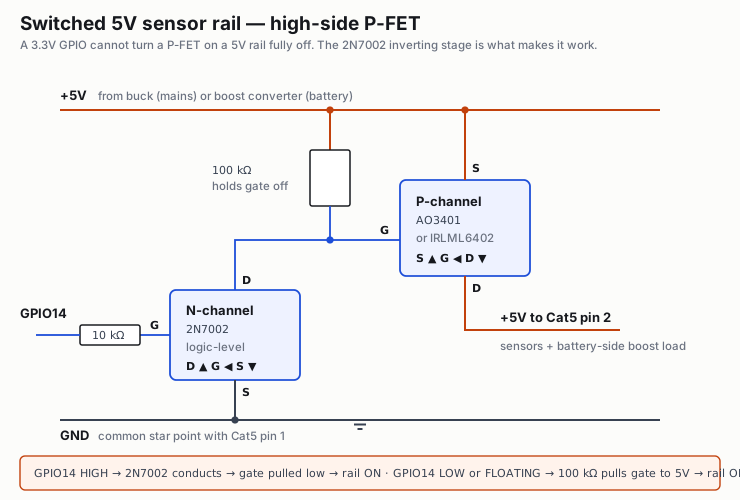
  - docs/WIRING.md notes the 18650 cannot feed the probes directly: the
    XC6206 LDO needs ~3.4V headroom, so a boost converter is required on the
    switched side of the MOSFET.

Both profiles compile clean under -Wall. Not yet run on hardware; pin map,
MOSFET circuit and calibration defaults are unverified against a board.

Co-Authored-By: Claude <noreply@anthropic.com>
4.7 KiB
4.7 KiB